
Quick Answer: The 12 YouTube video ideas with the strongest retention rates share one thing in common — they follow a proven structural framework, not just a good topic. Formats like tutorials, story-driven vlogs, reaction breakdowns, and challenge videos consistently outperform random uploads because they give viewers a reason to stay. If you apply these high-retention frameworks to your content, you will see measurable improvements in watch time and channel growth.
Key Takeaways
- Audience retention, not view count, is the metric YouTube’s algorithm rewards most heavily
- The best-performing video formats include tutorials, listicles, challenge videos, storytelling vlogs, and reaction breakdowns
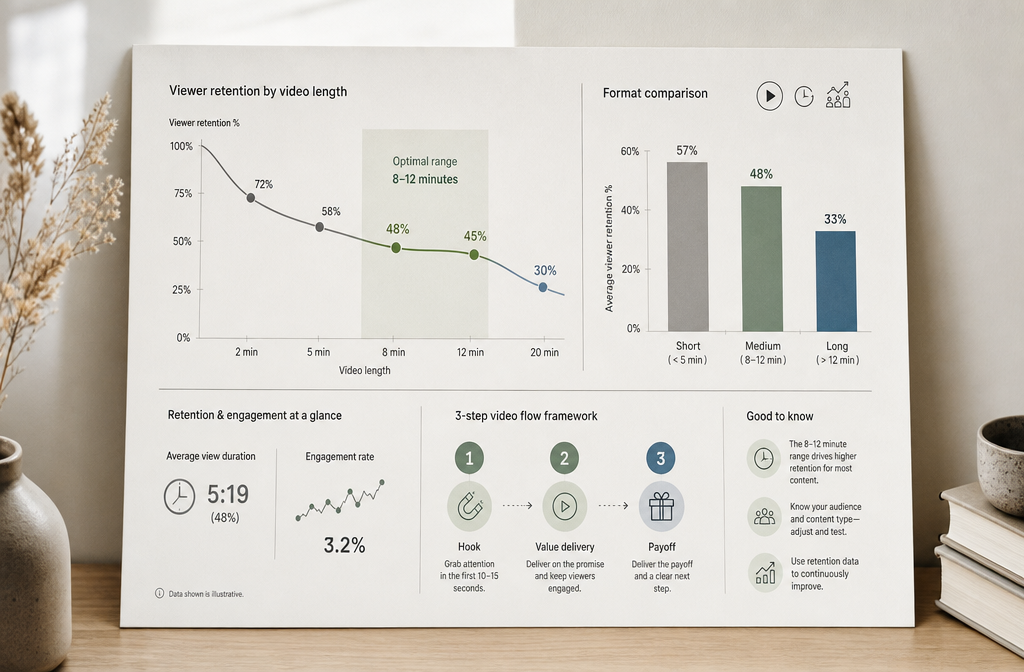
- Videos between 8 and 15 minutes tend to hold the strongest average retention for most niches
- A strong hook in the first 30 seconds is the single biggest factor in whether viewers stay or leave
- Thumbnails and titles work together — a high click-through rate (CTR) means nothing if retention collapses immediately after
- YouTube Shorts can feed your main channel by converting short-form viewers into long-form subscribers
- Common beginner mistakes — like slow intros and no clear structure — are easy to fix once you know what to look for
- Free tools like YouTube Studio analytics show exactly where viewers drop off, so you can fix weak spots in future videos
What Are the Best Video Formats for YouTube Retention
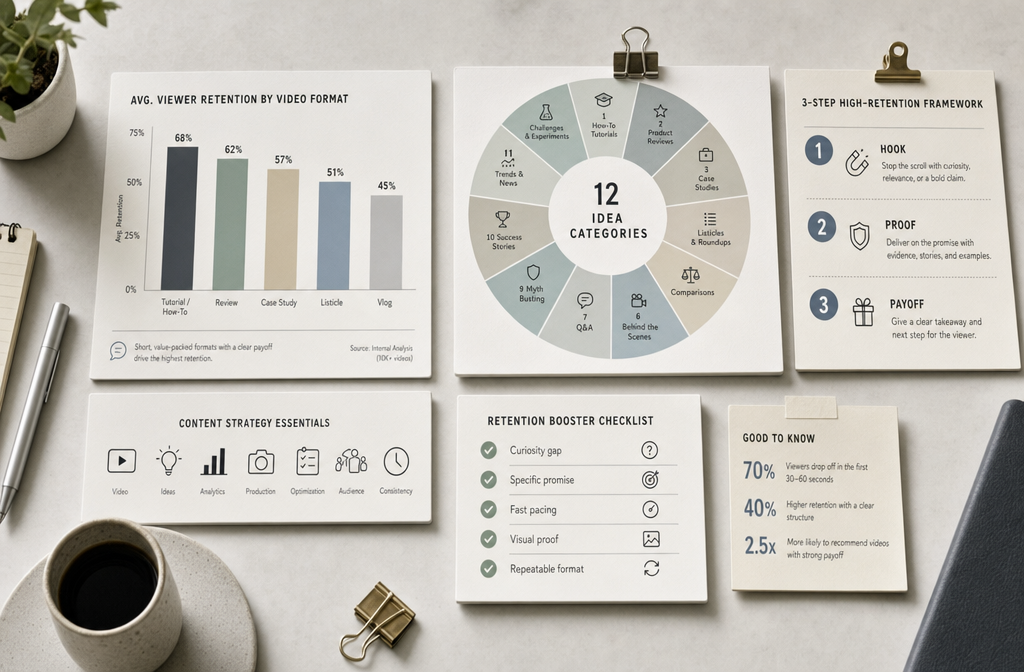
The video formats that consistently drive high audience retention are tutorials, listicle-style videos, storytelling vlogs, challenge videos, and reaction or commentary breakdowns. Each of these works because it creates a built-in reason for viewers to keep watching — either to get an answer, see what happens next, or follow a clear progression.
Here are the 12 YouTube video ideas and their core retention frameworks:
| Video Format | Retention Hook | Best Niche Fit |
|---|---|---|
| Step-by-step tutorial | Viewers need the final result | Tech, cooking, beauty, DIY |
| Numbered listicle | Curiosity about remaining items | Education, finance, lifestyle |
| Story-driven vlog | Emotional investment in outcome | Travel, personal growth, fitness |
| Challenge video | Suspense and resolution | Entertainment, fitness, food |
| Reaction/commentary | Shared experience and opinion | Gaming, pop culture, news |
| Day-in-the-life | Relatability and aspiration | Business, parenting, creators |
| Product review | Purchase decision payoff | Tech, beauty, gear |
| Myth-busting video | Desire to know the truth | Health, science, finance |
| Q&A or AMA | Personal connection | Any niche with an audience |
| Before and after | Transformation payoff | Fitness, home, creative skills |
| Documentary-style deep dive | Narrative tension | History, crime, business |
| Collaboration or interview | Social proof and novelty | Any niche |
Each format works because it answers the viewer’s unspoken question: “Why should I keep watching?” If your video can’t answer that within the first 30 seconds, retention will drop fast.
For more creative starting points, check out 101 YouTube Challenge Ideas to Go Viral and Over 200 Q&A Questions for YouTube Videos.
How Long Should YouTube Videos Be to Keep Viewers Watching
For most niches, videos between 8 and 15 minutes hold the best balance of retention and watch time. Shorter videos (under 5 minutes) can work well for quick tutorials or Shorts-adjacent content, but they limit your ability to build narrative tension or depth. Videos over 20 minutes need exceptionally strong structure to avoid drop-off.
The right length depends on your format:
- Tutorials and how-tos: 8 to 12 minutes — long enough to be thorough, short enough to stay focused
- Listicle videos: 10 to 15 minutes — one item per minute is a reliable pacing rule
- Story vlogs and documentaries: 12 to 20 minutes — narrative needs room to breathe
- Q&A and reaction videos: 8 to 12 minutes — variety keeps energy up
The key rule: your video should be exactly as long as it needs to be. Cut anything that doesn’t serve the viewer. Dead air, long intros, and filler commentary are the fastest ways to lose someone.
Which YouTube Niches Have the Highest Audience Engagement
Finance, personal development, tech tutorials, and fitness consistently show above-average audience engagement because viewers come with a specific problem they need solved. When someone needs to know how to budget or fix a software issue, they are motivated to watch until they get the answer.
High-engagement niches for 2026 include:
- Personal finance and investing
- Career development and side income
- Health, fitness, and nutrition
- Tech reviews and software tutorials
- True crime and documentary-style storytelling
- Gaming (especially guides and commentary)
- Parenting and family lifestyle
If you prefer not to appear on camera, many of these niches work brilliantly as faceless channels. See 50 Faceless YouTube Video Ideas for a full breakdown of formats that don’t require you to show your face.
Are Storytelling Videos Better Than Tutorial Videos for Retention
Neither format is universally better — they serve different audience needs. Tutorials drive high retention because viewers have a specific goal and won’t leave until they reach it. Storytelling videos drive emotional investment, which can produce longer watch sessions and stronger subscriber loyalty.
The smartest approach is to blend both. Start with a short personal story or relatable problem (30 to 60 seconds), then move into the tutorial or instructional content. This is sometimes called the “story-then-solve” framework, and it consistently outperforms cold, instruction-only videos.
Common mistake: Starting with “Hey guys, welcome back to my channel” before saying anything of value. That phrase alone can cost you 15 to 20 percent of viewers in the first 10 seconds.
What Equipment Do You Need to Create High-Retention YouTube Content
You don’t need expensive gear to make videos that hold attention. A smartphone with good lighting and clear audio will outperform a professional camera with poor sound every single time. Audio quality is the most underestimated factor in viewer retention — bad audio makes people leave immediately.
Minimum viable setup:
- Smartphone or entry-level mirrorless camera
- A lavalier or USB microphone (clear audio is non-negotiable)
- One softbox or ring light for consistent lighting
- Free editing software like DaVinci Resolve
Upgrade path when you’re ready:
- A dedicated mirrorless camera (see Best Canon Cameras for Vlogging)
- A wireless microphone for mobility (see Best Wireless Microphones for YouTube)
- A proper backdrop or set design (see 20 Eye-Catching YouTube Backdrops Ideas)
The gear matters less than the framework. A well-structured video shot on a phone will retain viewers longer than a poorly structured video shot on a cinema camera.

What Common Mistakes Do New YouTubers Make That Kill Viewer Interest
The most common retention killers are slow introductions, no clear structure, and videos that don’t deliver on the promise of the title or thumbnail. New creators often spend the first two minutes explaining what the video is about instead of just starting the video.
Other mistakes that hurt retention:
- No hook in the first 30 seconds — viewers decide to stay or leave almost immediately
- Rambling without a script or outline — structure keeps pacing tight
- Ignoring audio quality — even slightly muffled audio causes drop-off
- Burying the payoff — if you promise a result, deliver it before the halfway point
- Inconsistent upload schedule — subscriber trust erodes when videos appear randomly
For a deeper look at what’s holding channels back, read 7 YouTube Mistakes That Kill Channel Growth.
How Do Successful YouTube Channels Structure Their Content
Successful channels follow a repeatable content structure that viewers learn to expect. The most effective framework is: hook, context, content, call to action. Each section has a job, and skipping any one of them weakens the whole video.
The four-part retention framework:
- Hook (0 to 30 seconds): State the payoff immediately. What will the viewer know or be able to do by the end?
- Context (30 to 90 seconds): Briefly explain why this matters. One relatable story or statistic works well here.
- Content (bulk of the video): Deliver what you promised, broken into clear sections with visual or verbal signposts.
- Call to action (final 30 to 60 seconds): Tell viewers what to watch next, subscribe, or do. Be specific.
For a practical guide on building this out across your whole channel, see How to Structure a YouTube Channel for Growth.
What Video Editing Techniques Improve Audience Retention
Jump cuts, pattern interrupts, and B-roll (supplementary footage that plays over your main audio) are the three editing techniques that have the biggest impact on retention. They keep the visual experience moving so viewers don’t get bored.
Practical editing techniques that work:
- Jump cuts: Remove pauses and filler words. Keeps energy high.
- B-roll cutaways: Show what you’re talking about, don’t just say it
- Text overlays: Reinforce key points visually — useful for viewers watching without sound
- Music beds: Subtle background music fills silence and maintains energy
- Pattern interrupts: Change the camera angle, cut to a graphic, or shift the scene every 60 to 90 seconds
Free editing tools like DaVinci Resolve handle all of these. See The Best Free Vlogging Software for a full comparison.
Can YouTube Shorts Help Grow Your Main Channel
Yes — YouTube Shorts can drive meaningful subscriber growth for your main channel when used strategically. The key is treating Shorts as a trailer, not a replacement. A 45 to 60-second Short that teases a longer video gives viewers a reason to click through to your channel page.
Effective Shorts strategies for channel growth:
- Clip the best 45 seconds from a long-form video and post it as a Short
- End every Short with a verbal or on-screen prompt pointing to the full video
- Post Shorts consistently (3 to 5 per week) to stay visible in the Shorts feed
- Use the same thumbnail style and branding as your main channel for visual consistency
Shorts audiences and long-form audiences do behave differently, so don’t expect every Short viewer to convert. But over time, a consistent Shorts presence builds brand recognition that supports your main channel.
How to Analyze Your YouTube Analytics for Retention Rate
YouTube Studio’s audience retention report shows exactly where viewers drop off in each video. Go to YouTube Studio, click on a video, select “Analytics,” then choose the “Engagement” tab. The retention graph shows a percentage of viewers still watching at each moment in the video.
What to look for:
- Sharp drop in the first 30 seconds: Your hook isn’t working — rewrite your intros
- Gradual decline after the midpoint: The content is too long or loses focus — tighten the second half
- Spikes (viewers rewinding): That section is valuable — make more content like it
- Cliffs (sudden drops): Something specific is causing viewers to leave — watch that moment and fix it
Average retention benchmarks vary by video length, but a 40 to 50 percent average view duration is generally considered solid for videos over 10 minutes. Anything above 60 percent is strong.
What Types of Thumbnails Get the Most Clicks and Views
Thumbnails with a single clear focal point, high contrast, and an emotional or curiosity-driven visual consistently outperform cluttered designs. The thumbnail’s job is to answer one question in under two seconds: “Is this video for me?”
Thumbnail elements that improve CTR (click-through rate, the percentage of people who see your thumbnail and click it):
- One dominant image: A face with a clear expression, a product, or a striking visual
- High contrast colors: Bright backgrounds against dark subjects, or vice versa
- Minimal text: Three to five words maximum, large enough to read on a phone screen
- Visual consistency: Same font, color palette, and style across all thumbnails builds brand recognition
For a detailed breakdown of what works and what doesn’t, read Why Your YouTube Thumbnails Aren’t Getting Clicks and The Secret Formula for High-CTR YouTube Titles and Thumbnails.
How Much Do Top YouTube Creators Make With High-Retention Videos
High retention directly increases revenue because YouTube’s ad system pays more for videos where viewers watch longer and see more ads. According to YouTube’s own creator documentation, channels with above-average retention qualify for mid-roll ads (ads placed in the middle of videos), which can significantly increase RPM (revenue per thousand views, the amount earned per 1,000 video views).
Earnings vary widely by niche, audience size, and monetization strategy:
- Ad revenue (AdSense): RPM typically ranges from $2 to $15 for general lifestyle content, and $10 to $50 or more for finance and business niches
- Sponsorships: High-retention channels command premium rates because sponsors know their message is actually being heard
- Merchandise and courses: Loyal, engaged audiences convert at higher rates than passive viewers
For a full breakdown of how creators earn across multiple income streams, see How Vloggers Make Money.
FAQ
What is audience retention on YouTube?
Audience retention is the percentage of a video that viewers watch on average. A 50 percent retention rate means the average viewer watches half the video. YouTube uses this metric to decide how widely to recommend your content.
How do I improve my YouTube retention rate quickly?
Start by fixing your hook. If viewers are leaving in the first 30 seconds, rewrite your intro to deliver value immediately. Cut any filler, slow intros, or channel branding that appears before the content starts.
Do longer videos always get more watch time?
Not automatically. A 15-minute video with 60 percent retention generates more watch time than a 20-minute video with 30 percent retention. Length only helps if the content justifies it.
What is a good click-through rate for YouTube thumbnails?
According to YouTube’s Creator Academy, most channels see a CTR between 2 and 10 percent. A CTR above 5 percent is generally considered strong, but it should always be read alongside retention data.
Can I grow a YouTube channel without showing my face?
Yes. Many successful channels in finance, education, tech, and storytelling niches operate entirely without on-camera presence. See 14 Video Ideas Without Showing Your Face for proven formats.
How often should I post on YouTube?
Consistency matters more than frequency. One well-structured video per week outperforms three rushed videos per week. Set a schedule you can maintain for at least three months before evaluating results.
What is RPM on YouTube?
RPM stands for revenue per mille, which means revenue per thousand views. It includes all monetization sources — ads, channel memberships, and Super Thanks — divided by total views. It’s a more complete earnings metric than CPM (cost per mille, what advertisers pay).
Are YouTube Shorts counted in channel analytics?
Yes, Shorts have their own analytics within YouTube Studio. Shorts views, subscribers gained, and retention are tracked separately from long-form content, so you can evaluate each format independently.
What is the best niche for a new YouTube channel in 2026?
Choose a niche where you have genuine knowledge or experience, and where there is clear search demand. Finance, health, and career development remain strong in 2026 because they solve specific, recurring problems for viewers.
How do I write a YouTube hook?
State the most compelling outcome of your video in the first sentence. For example: “By the end of this video, you’ll know exactly why your retention drops after two minutes — and how to fix it today.” Then go straight into the content.
Conclusion
The 12 YouTube Video Ideas: High-Retention Frameworks That Work covered in this guide aren’t just creative formats — they’re structural tools. Every one of them works because it gives viewers a clear reason to stay. Tutorials promise a skill. Challenges promise a result. Story-driven vlogs promise an emotional payoff. When your video delivers on that promise, retention goes up, watch time increases, and YouTube’s algorithm takes notice.
Your next step is straightforward: pick one format from the table above, apply the four-part retention framework (hook, context, content, call to action), and publish. Then open YouTube Studio and check your retention graph. Find where viewers drop off, fix that one moment, and repeat. Small, consistent improvements compound fast.
If you’re not sure where to start, run a quick YouTube Channel Audit to identify the biggest gaps in your current setup. Then come back to this guide and match each gap to the right framework.
References
- YouTube Creator Academy. “Audience Retention.” support.google.com/youtube. Accessed 2024.
- YouTube Help. “Understanding Your Analytics.” support.google.com/youtube. Accessed 2024.
- YouTube Creator Blog. “How YouTube Recommends Videos.” blog.youtube. Accessed 2023.
YouTube Video Framework Selector
Answer two quick questions and get the best high-retention video format for your channel.


