Quick Answer: The 14 YouTube content ideas that consistently attract viewers include tutorials, vlogs, reaction videos, product reviews, challenges, Q&As, listicles, day-in-the-life videos, opinion pieces, storytime videos, comparison videos, behind-the-scenes content, news commentary, and documentary-style videos. Each format works across different niches and skill levels, and the best choice depends on your audience’s specific interests and your own strengths as a creator.
Key Takeaways
- Tutorial and how-to videos remain the top-performing content type on YouTube in 2026, driven by search intent
- Beginners can start with Q&As, vlogs, or listicle-style videos using just a smartphone
- Video length should match content type: 8-15 minutes for tutorials, 5-10 minutes for vlogs and reviews
- Reaction and challenge videos drive high engagement but need a consistent niche to build a loyal audience
- YouTube Analytics is the most reliable tool for understanding what your specific audience wants to watch
- Viral ideas are not always sustainable — pairing trending formats with evergreen topics is the smarter long-term strategy
- You do not need expensive gear to start; a smartphone, decent lighting, and a clip-on microphone are enough
- Avoid clickbait, misleading titles, and copying competitors without adding your own perspective
What Are the Most Popular YouTube Content Types Right Now
Tutorial and how-to videos consistently rank as the most-watched content on YouTube. According to Google, “how to” searches on YouTube grow by roughly 70% year over year (Google, 2015 — the trend has only continued since). Beyond tutorials, the formats driving the most views in 2026 include:
- Tutorials and how-tos — evergreen, search-driven, high watch time
- Vlogs and day-in-the-life videos — personal, relatable, builds community
- Product reviews and comparisons — strong purchase intent from viewers
- Reaction videos — high engagement, easy to produce
- Challenge videos — shareable and community-driven
- Listicle videos (e.g., “Top 10 budget cameras”) — skimmable and SEO-friendly
- Opinion and commentary — builds loyal, opinionated audiences
- Storytime videos — emotionally engaging and highly rewatchable
- Q&A and Ask Me Anything (AMA) — deepens audience connection
- Behind-the-scenes content — builds trust and authenticity
- News commentary — taps into trending search traffic
- Documentary-style videos — longer watch time, strong retention
- Comparison videos — ideal for viewers making decisions
- Niche educational content — positions you as an authority
These 14 YouTube content ideas cover the full spectrum of what your audience actually wants, from quick entertainment to in-depth learning.
Which YouTube Content Ideas Work Best for Beginners
Beginners do best with formats that require minimal editing and gear. Q&A videos, vlogs, and simple listicle-style videos are the lowest barrier to entry because they rely on personality and information rather than production complexity.
Start here if you are just getting going:
- Q&A videos — answer questions your audience is already asking; check Reddit, Quora, and YouTube comments for ideas. See our collection of over 200 Q&A questions for YouTube videos for a ready-made starting point.
- Day-in-the-life vlogs — no script needed, just document your day honestly
- Listicle videos — structured, easy to film in segments, and naturally SEO-friendly
Not comfortable being on camera yet? Faceless YouTube video ideas are a legitimate and growing format — voiceover-driven content, screen recordings, and animated explainers all perform well without showing your face.
What Equipment Do You Need to Start Making YouTube Videos
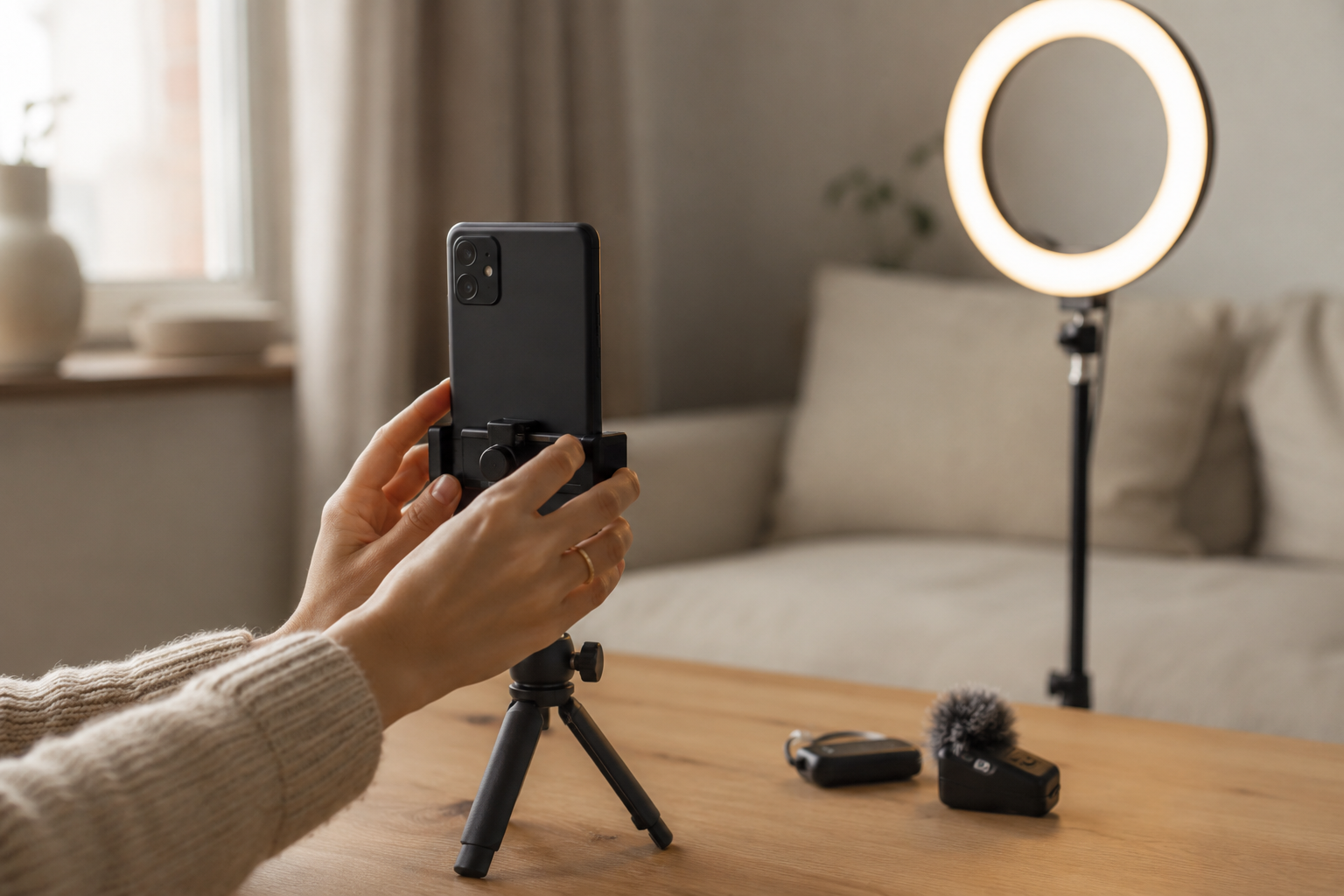
You need less than you think. A smartphone, a clip-on microphone, and decent natural light are enough to publish your first video. Upgrading gear later makes sense, but it should never be the reason you delay starting.
Starter kit (budget-friendly):
| Item | Purpose | Estimated Cost |
|---|---|---|
| Smartphone (any recent model) | Primary camera | Already own |
| Clip-on lavalier microphone | Clear audio | $20-$50 |
| Ring light or window light | Flattering, consistent lighting | $0-$40 |
| Free editing software | Post-production | $0 |
Audio quality matters more than video quality. Viewers will click away from bad sound far faster than slightly soft visuals. For lighting options, the best lights for vlogging and YouTube guide covers affordable setups from ring lights to softboxes.
When you are ready to upgrade, check out the DIY vs. professional YouTube setup guide to decide what is actually worth spending money on.
How Long Should Your YouTube Videos Be
Video length should match the content type and viewer intent. There is no single “best” length, but data from YouTube creators consistently points to these ranges performing well:
- Tutorials: 8-15 minutes (enough depth to be useful, short enough to hold attention)
- Vlogs: 5-12 minutes
- Product reviews: 6-10 minutes
- Reaction videos: 5-8 minutes
- Documentary-style: 15-30 minutes (only if the topic warrants it)
The real goal is to make every second earn its place. A tight 7-minute video will outperform a padded 20-minute one every time. If your audience is dropping off at the 2-minute mark, that is a structure problem, not a length problem.
Which Content Ideas Have the Highest Engagement Rates
Challenge videos, reaction videos, and opinion-based commentary consistently generate the highest comment counts and share rates. These formats invite viewers to respond, disagree, or participate — which drives the engagement signals YouTube’s algorithm rewards.
For sustained engagement across all 14 YouTube content ideas:
- Challenges — viewers tag friends and recreate them; explore 101 YouTube challenge ideas for inspiration
- Opinion videos — polarising (but fair) takes spark comment debates
- Q&As — viewers feel heard when their questions get answered on screen
- Tutorials — high save rates and return visits, which signals strong value to the algorithm
Common mistake: chasing engagement without a niche. A challenge video on a cooking channel will outperform the same video on a channel with no clear identity, because the audience already trusts the creator.
How Do Different Niches Attract More Viewers
Each niche attracts viewers through a different core motivation. Understanding that motivation helps you pick the right format from the 14 YouTube content ideas that genuinely fits your channel.
| Niche | Core viewer motivation | Best-fit content types |
|---|---|---|
| Finance | Learning, decision-making | Tutorials, comparisons, listicles |
| Fitness | Motivation, instruction | Vlogs, tutorials, challenges |
| Gaming | Entertainment, community | Reaction, commentary, challenge |
| Beauty/Fashion | Inspiration, product info | Reviews, tutorials, GRWM vlogs |
| Tech | Research before buying | Reviews, comparisons, how-tos |
| Lifestyle | Connection, aspiration | Day-in-the-life, behind-the-scenes |
Choose a content type that matches why your viewers show up, not just what is trending on the platform.
How Do You Know What Your Specific Audience Wants to Watch
YouTube Analytics is your most reliable answer. Go to YouTube Studio, open the Analytics tab, and look at your top-performing videos by watch time (not just views). That data tells you what your existing audience actually finishes watching, which is far more useful than guessing.
Beyond Analytics:
- Read every comment and note recurring questions
- Check the “Search terms” report to see what people typed before finding your channel
- Use YouTube’s autocomplete feature to spot what your niche audience is actively searching
- Poll your community tab or end screens to ask directly
If your channel is brand new and you have no data yet, research competitors in your niche. Look at their most-viewed videos from the last 6-12 months — that is a reliable proxy for what your shared audience wants.
If your channel is struggling to get traction, the guide to fixing a YouTube channel that is not growing walks through a practical audit process.
Are Viral YouTube Content Ideas Sustainable Long-Term
Viral ideas are not a strategy on their own. A single viral video can spike your subscriber count, but if the follow-up content does not match viewer expectations, those subscribers will go inactive fast.
The sustainable approach pairs trending formats with evergreen topics. For example, a challenge video (trending format) about budgeting for beginners (evergreen topic) gives you short-term discoverability and long-term search traffic.
Creators who build durable channels typically do this:
- Identify 2-3 content formats their audience loves
- Apply those formats to both trending and evergreen topics
- Publish consistently rather than chasing every trend
Viral moments are a bonus, not a business plan.
What Topics Should You Avoid on YouTube
Avoid content that misleads, exploits, or violates YouTube’s Community Guidelines — not just for ethical reasons, but because demonetisation and strikes will kill your channel growth. Beyond policy issues, also avoid:
- Clickbait with no payoff — destroys trust and tanks your click-through rate over time
- Copying competitors without adding your own perspective — viewers can tell, and it rarely ranks
- Overly broad topics — “How to be happy” will not rank; “How to build a morning routine when you have anxiety” will
- Controversial topics outside your niche — they attract the wrong audience and confuse the algorithm
For a deeper look at what hurts rankings, the YouTube SEO mistakes guide is worth bookmarking.
What Skills Do You Need to Create Compelling YouTube Content
You need four core skills, and all of them are learnable: storytelling, basic editing, on-camera confidence (or voiceover delivery), and consistency. You do not need a film degree.
- Storytelling — every video needs a beginning, a middle, and a payoff. Even a product review tells a story: problem, test, verdict.
- Basic editing — cut dead air, add captions, use jump cuts to keep pace. Free vlogging software handles everything a beginner needs.
- Thumbnails and titles — these determine whether anyone clicks. A great video with a weak thumbnail gets ignored. The guide to high-CTR YouTube titles and thumbnails covers the mechanics clearly.
- Consistency — one video per week beats three videos one week and nothing for a month.
How Much Money Can You Make With These Content Ideas
Income varies widely and depends on niche, audience size, and monetisation method. YouTube’s Partner Program (YPP) pays creators based on CPM (cost per thousand views), which ranges from roughly $1-$20 depending on niche and audience location. Finance and business channels typically earn higher CPMs than entertainment channels.
Beyond ad revenue, creators earn through:
- Sponsorships — often the highest income source for mid-size channels. See the step-by-step guide to getting YouTube sponsors for how to approach brands.
- Affiliate marketing — earn a commission when viewers buy products you recommend
- Digital products and courses — high margin, no inventory
- Channel memberships — recurring income from loyal viewers
A realistic expectation for a new creator: it takes most channels 12-18 months of consistent posting to reach the 1,000 subscribers and 4,000 watch hours needed for YPP eligibility.

Are These Content Ideas Good for All Age Groups
Most of the 14 YouTube content ideas work across age groups, but the framing and platform context matter. Tutorials, reviews, and vlogs appeal broadly. Challenge videos and reaction content skew younger. Documentary-style and opinion commentary tend to attract older, more engaged viewers.
The key is not the format itself — it is how you position it. A cooking tutorial aimed at college students on a budget will perform differently from the same format aimed at parents meal-prepping for a family. Same idea, different framing, different audience.
What Common Mistakes Do New YouTubers Make
New creators consistently make the same handful of mistakes. Knowing them upfront saves months of frustration.
- Inconsistent upload schedules — the algorithm rewards channels that publish regularly
- Ignoring audio quality — bad sound is the fastest way to lose a viewer
- No clear niche — a channel about everything is a channel about nothing
- Skipping the thumbnail — your thumbnail is your billboard; a rushed one costs you clicks. Check out why your YouTube thumbnails are not getting clicks for a practical fix
- Giving up too early — most channels that succeed took 6-18 months to gain real traction
For a full breakdown, the 7 YouTube mistakes that kill channel growth covers each one with specific fixes.
FAQ
What is the easiest YouTube content idea for a complete beginner?
Q&A videos and day-in-the-life vlogs are the easiest starting points. They require minimal editing, no special equipment, and rely on your personality and knowledge rather than production skill.
Can I make YouTube videos without showing my face?
Yes. Voiceover tutorials, screen recordings, animated explainers, and compilation-style videos all perform well. Many successful channels are entirely faceless.
How often should I post on YouTube as a beginner?
Once a week is a sustainable and effective starting frequency. Consistency matters more than volume — two videos a week that burn you out is worse than one video a week for two years.
Do I need to pick one content type and stick with it?
Not strictly, but your channel should have a clear niche even if you vary the format. A fitness channel can post tutorials, vlogs, and challenges — but all three should serve the same core audience.
What is the fastest way to grow a YouTube channel in 2026?
Combine strong SEO (keyword-optimised titles and descriptions) with high-click-through-rate thumbnails and consistent uploads. There is no shortcut, but those three factors compound quickly when done together.
How do I find out what topics are trending in my niche?
Use YouTube’s search autocomplete, Google Trends, and the “Trending” tab filtered by category. Also check the comments on your competitors’ most recent videos — viewers often request topics directly.
Does video length affect YouTube monetisation?
Videos over 8 minutes can include mid-roll ads, which increases ad revenue potential. However, a shorter video with high retention will outperform a longer video with poor retention in both rankings and earnings.
What is CPM on YouTube?
CPM stands for cost per mille, meaning the amount advertisers pay per 1,000 ad impressions. Higher CPM niches (finance, software, business) earn more per view than entertainment or gaming channels.
Can these 14 YouTube content ideas work for a brand channel, not just a personal creator?
Yes. Brands use tutorials, behind-the-scenes, and comparison videos effectively. The key is making the content genuinely useful to the viewer rather than purely promotional.
How do I keep viewers watching until the end of my video?
Open with a clear promise of what the viewer will get, deliver on it efficiently, and use pattern interrupts (cuts, B-roll, questions) every 60-90 seconds to reset attention.
Conclusion
The 14 YouTube content ideas covered here are not just a list — they are a framework for understanding what your audience actually wants and why certain formats work better than others in specific niches. The creators who grow consistently are not the ones with the best cameras or the most creative ideas. They are the ones who understand their audience, show up regularly, and keep improving one video at a time.
Your next step is simple: pick one format from this list that fits your niche and your current skill level, and publish your first (or next) video this week. Check your Analytics after 48 hours. See what worked, adjust one thing, and do it again.
That is how channels are built.
References
- Google/YouTube. (2015). How-to searches on YouTube. Think with Google. https://www.thinkwithgoogle.com
YouTube Content Idea Finder
Answer 3 quick questions to find the best content format for your channel.