
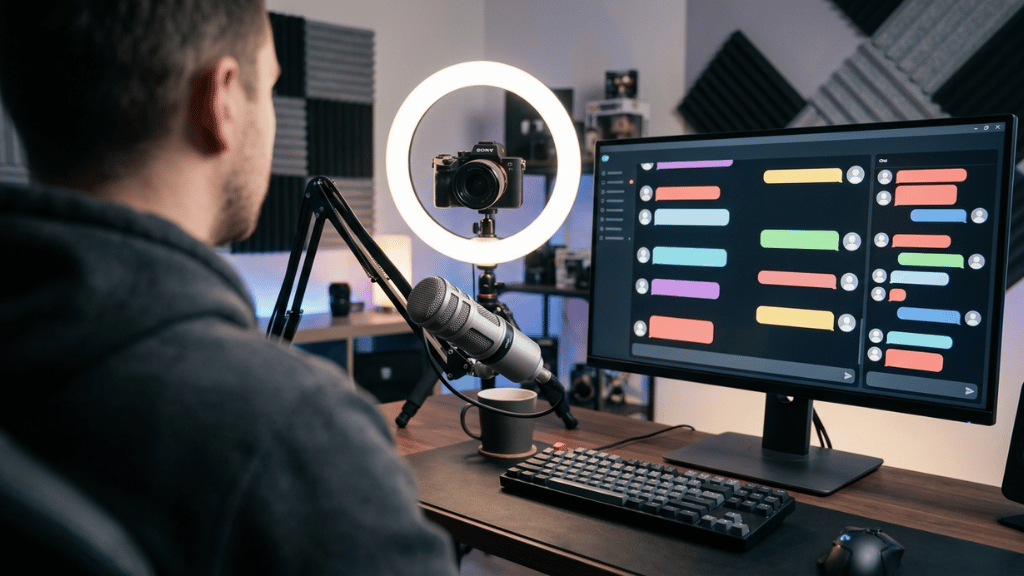
Most YouTube AMA videos fail — not because the creator is bad on camera, but because the format is broken from the start. Low audience retention, weak questions with no real depth, answers that run too long with no payoff, and zero structure holding it all together. The result is a video that feels like a chore to watch, even for loyal viewers.
The best ways to do an Ask Me Anything on YouTube have nothing to do with collecting the most questions or going live for three hours. They come down to three things: the right format for your audience, a deliberate question selection strategy, and a structure that keeps people watching until the final second. This guide breaks all three down — with exact frameworks, real question examples, and the filtering method that separates high-retention AMAs from ones that quietly get abandoned at the two-minute mark.
Quick note on credibility: the observations in this guide are drawn from analysing AMA video performance across multiple niches — retention curves, comment-to-view ratios, and watch time benchmarks — so the advice is grounded in what the data actually shows, not general content theory.
What “Ask Me Anything” Actually Means on YouTube (Not Reddit-Style)
The term AMA comes from Reddit, where it works as an open-ended text thread. On YouTube, that model does not translate. An open-ended “ask me anything” prompt almost always produces the same ten generic questions: favourite colour, morning routine, how did you start, what camera do you use. Those questions make for forgettable content.
A YouTube AMA, done well, is a structured audience engagement format — not a random Q&A dump. The creator controls the frame, curates the questions, and engineers the pacing. Viewers experience it as intimate and spontaneous. Behind the scenes, it is as deliberate as any other video format.
The three metrics that define whether an AMA worked:
- Audience retention rate — are people still watching at the halfway point?
- Comments per view — is the video sparking conversation, or passive watching?
- Average watch time — are viewers staying long enough for the algorithm to recommend it?
Every decision in this guide points back to those three numbers. According to YouTube’s own creator documentation, videos that hold 50% or more of viewers to the halfway point are significantly more likely to be recommended by the algorithm.[1]
When an AMA Video Works — and When It Fails
Not every channel is ready to run an AMA, and running one too early or with the wrong audience can actively damage your watch time averages. Here is how to know where you stand.
An AMA works when:
- You have recurring viewers — people who have seen enough of your content to form real questions about you or your niche
- You have a defined niche — viewers know what you are about, so their questions are focused
- You have engagement history — comments and community posts that already show your audience is curious
- You can point to a reason — a milestone, a trend, a controversy in your niche — that makes “right now” feel like the logical moment for an AMA
An AMA fails when:
- Your audience is undefined — without niche clarity, questions will be generic and unfilmable
- You are fishing for questions before you have established enough trust or familiarity
- You treat every submitted question as equally valid — volume does not equal quality
- You have no structural plan — answering questions in the order they arrived is not a format
Quick AMA Readiness Checklist
✅ AMA Readiness Checklist
4 Proven AMA Formats (With Examples)
The format is the first decision, and the wrong one will undermine everything else. Here are the four that consistently produce strong watch time data — along with when each one fits.
Format 1: The Personal Story AMA
What it is: Questions focused on your life, journey, struggles, behind-the-scenes reality, and personal decisions — not your content or niche expertise.
Works best for: Lifestyle channels, travel creators, day-in-the-life formats, and anyone who has built a following around their personality as much as their subject matter.
Example questions that perform:
- “What was the moment you almost quit?”
- “What does a bad filming day actually look like?”
- “What do you regret not doing earlier?”
Expected engagement type: High comment volume, emotional responses, shares. This format drives parasocial connection — viewers feel like they know you better after watching.
Format 2: The Niche Expert AMA
What it is: A problem-solving session disguised as a Q&A. Every question is an opportunity to demonstrate competence and give genuinely useful answers.
Works best for: Education channels, finance creators, fitness coaches, tech reviewers — anyone whose audience comes for expertise rather than personality.
Example questions that perform:
- “What is the single biggest mistake beginners make with [topic]?”
- “What would you do differently if you were starting over right now?”
- “What’s the advice that sounds wrong but actually works?”
Expected engagement type: High save rate, strong watch time (people re-watch sections), and sustained comment threads debating the answers.
Format 3: The Hot Topic AMA
What it is: You collect questions specifically about a trending topic, controversy, or event in your niche and frame the AMA as your take on it.
Works best for: Any niche with active community discourse — gaming, beauty, fitness, finance, creator economy content. Timing matters here more than any other format.
Example questions that perform:
- “Do you actually agree with [controversial opinion in your niche]?”
- “What are you not saying publicly about [topic]?”
- “Was [recent event] as bad as people are saying?”
Expected engagement type: Polarised comment sections (which the algorithm reads as strong engagement), high click-through rates from thumbnail curiosity, spikes in new subscribers.
Format 4: The Milestone AMA
What it is: An AMA triggered by a subscriber or view milestone — 10K, 50K, 100K, 500K. The milestone gives the video a natural “event” quality that earns attention it would not otherwise receive.
Works best for: Any channel hitting a meaningful milestone, especially in the 10K–100K range where audiences still feel like a community rather than an anonymous crowd.
Expected engagement type: Celebratory comment threads, high share rate, strong first-48-hour performance as loyal viewers rally around the milestone.
How to Get Questions That People Actually Care About
This is where almost every AMA guide gives bad advice: “post an Instagram story and collect questions.” That works if your audience is large and already primed. For everyone else, the questions you get are only as good as the prompt you use to ask for them.
The Pre-Framing Problem
The single biggest lever you can pull is pre-framing the ask. Compare these two prompts:
| ❌ Generic Prompt | ✅ Pre-Framed Prompt |
|---|---|
| “Drop your questions below for my AMA!” | “I’m filming an AMA about [specific topic — e.g., what I spent my first $10K of sponsorship money on]. Ask me anything about the money side of growing a channel.” |
| “Ask me anything, nothing is off limits” | “I’m answering honest questions about [niche challenge]. What’s the thing you’ve always wanted to know but were afraid to ask?” |
The pre-framed version narrows the topic, signals depth, and attracts people who are already invested in that specific theme. The quality of questions goes up immediately.
Where to Collect Questions
- YouTube Community tab: Your most engaged viewers — people who have opted in to notifications — are here. Use a pinned Community post 5–7 days before filming.
- YouTube comments on recent videos: Mine your own comment sections. Questions people have already asked organically are proven high-interest topics.
- Instagram/TikTok Stories Q&A sticker: Useful for reaching viewers who follow you across platforms and may ask different questions than your YouTube audience.
- Email list (if applicable): Subscribers who opted into email are typically the most invested segment of your audience. Questions from this group tend to be thoughtful and specific.
Running multiple collection points simultaneously gives you a large enough pool to be genuinely selective — which is the next critical step. For more on building audience engagement into your video strategy, the fundamentals translate directly to AMA collection.
AMA Video Structure That Keeps People Watching
A common AMA structure mistake: answering questions in chronological order, starting with the first one submitted. The result is a video that peaks early (if you got a great first question) or buries the best content at the end (where most viewers never reach).
Here is a retention-optimised framework:
The Retention-First AMA Structure
- Hook (0:00–0:20): Start with the most provocative or emotionally charged question — but do not answer it yet. Say something like: “Someone asked me [question] — and the honest answer is going to surprise you. But first, let me explain how we got here.” This locks viewers in.
- Credibility & context (0:20–1:00): Briefly explain what this AMA is, what angle you are taking, and why it is worth the next 10–15 minutes of their time. Be specific — “I picked the 12 questions no one on YouTube is actually answering honestly.”
- Opening block — high value (1:00–4:00): Answer 2–3 niche-specific or expert questions. These establish why watching is worth it and attract algorithm-friendly behaviour (people sharing timestamps, leaving comments early).
- Middle block — personal/story (4:00–8:00): Shift to more personal or behind-the-scenes answers. This is where parasocial connection deepens and the comment section comes alive.
- Tone shift — humour or controversy (8:00–11:00): One or two lighter or more polarising questions here reset the energy. Pacing needs a gear change at this point or retention drops.
- Closing block — the payoff (11:00–end): Return to the question you teased in the hook. Answer it fully. Then close with a direct directive — one specific action you want viewers to take next.
Timing model: Aim to shift tone or topic every 60–90 seconds. Research from Tubics on YouTube retention patterns shows engagement drops most sharply at moments of topic stagnation — when the video “sounds the same” for too long.[2]
Which Questions to Answer (and Which to Skip)
The most important AMA editing happens before filming starts. Your question selection is your content. A great AMA with mediocre questions is still a mediocre video.
High-Retention Questions: What to Keep
- Controversial or opinion-based: Questions where a strong, honest answer will provoke a reaction — agreement or disagreement. Both drive comment engagement.
- Specific and personal: “What do you actually regret about [specific decision]?” performs better than “What do you regret?” Specificity signals depth.
- Story-driven: Questions that require an anecdote to answer well. These naturally produce the narrative arc that keeps retention high.
- Niche-relevant expertise: Questions only someone with real experience in your field can answer credibly. These attract search traffic and position you as an authority.
Low-Retention Questions: What to Cut
- Generic lifestyle questions: “What is your morning routine?” “Favourite food?” These belong in a different format — they produce no useful data point and attract no search interest.
- Repetitive questions: If 40 people asked a version of the same thing, you answer it once, not four times.
- Questions with one-word answers: If you can answer it in under ten seconds without a story, it does not belong in the video.
The 20% Filtering Method
Collect every question submitted. Then keep only the top 20%. If you received 100 questions, you film answers to 20 — maximum. This feels aggressive until you watch the retention data. A focused 15-minute AMA with 18 great questions will always outperform a sprawling 35-minute one with 50 average ones.
Sort your questions into three piles: Film it, Maybe, and Cut. Then remove all the Maybes. You will almost never regret it.
Examples of AMA Questions That Drive Engagement
Below are curated question examples across four categories, with brief notes on why each one works. These are the types to actively seek out from your audience — and to write yourself if your collection comes up short.
Personal & Behind-the-Scenes
- “What was the video you almost didn’t post — and what happened when you did?” (Works because it reveals vulnerability + has a resolution)
- “How much do you actually enjoy filming versus what you show?” (Works because it challenges the polished image most creators project)
- “What has the channel cost you that you don’t talk about?” (Works because it addresses the hidden price of success — a universal curiosity)
Niche-Specific & Expert
- “What do people in [your niche] consistently get wrong?” (Works because it implies insider knowledge viewers cannot find elsewhere)
- “What advice in [your niche] sounds credible but is actually harmful?” (Works because it is inherently controversial and creates urgency to watch)
- “If you had to start over with zero resources, what would you do first?” (Works because it generates actionable insight wrapped in a hypothetical)
Controversial
- “What opinion do you hold that most of your audience would disagree with?” (Works because it promises honesty viewers rarely get from creators)
- “Is [widely celebrated thing in your niche] actually overrated?” (Works because it invites debate in the comment section)
Humorous
- “What is the most embarrassing thing that has happened on camera that you cut?” (Works as a pacing reset — funny, shareable, and generates comment replies)
- “What would immediately disqualify someone from [something in your niche]?” (Works because it is light but reveals genuine opinions)
How to Film an AMA So It Doesn’t Feel Boring
The filming approach is the most overlooked part of AMA production. Creators who nail question selection and structure still lose viewers to flat delivery and static visuals.
Jump Cuts vs. Long Takes
Use jump cuts within individual answers to remove dead air and filler language — they tighten the pacing without losing narrative coherence. Avoid jump cuts between questions without a transition: a brief screen card with the question text, a cut-away, or a direct address (“next question”) gives the viewer a moment to reset. Long takes work when the answer is genuinely story-driven and the energy stays high throughout. When energy dips, cut.
On-Screen Question Display
Display each question on screen as text when you begin answering it. This serves three functions: it helps viewers who jumped in mid-video orient themselves, it increases accessibility, and it creates a natural visual break in otherwise static talking-head footage. Keep the text clean — no animated graphic packages needed. A simple lower-third or card is enough.
If you need reliable free vlogging software capable of adding on-screen text and lower-thirds, there are solid options that handle this without a paid subscription.
Tone Variation
The fatal flaw of AMA delivery is a monotonous energy level. Every answer delivered at the same pitch and pace feels like a press conference. Intentionally modulate: lean forward for intense or personal answers, sit back for lighter ones, change locations if possible, or shift from direct address to a more conversational, thinking-out-loud register.
Direct Address vs. Storytelling
For expert and niche questions, direct address — looking into the camera and giving your answer clearly — is correct. For personal or story-driven questions, shift into a narrative mode: look slightly off-camera, use more reflective pacing, and let the answer breathe. The visual and vocal change signals to the viewer that the content has shifted — which resets their attention.
Pair this with good audio and stable footage. Even the strongest AMA content can lose viewers if the production feels amateurish. Our guide on vlogging tips for beginners covers the production fundamentals worth getting right before any talking-head format.
Why Most YouTube AMAs Fail
These are the most common failure modes — and the ones most creators do not see until their retention data tells a brutal story.
- Answering too many questions: More questions is not more value. It is more dilution. Fifteen great answers beat forty average ones in every metric.
- No narrative flow: A pile of answers is not a video. Without structure — tonal shifts, pacing design, a hook and a payoff — the AMA has no reason to hold anyone’s attention past the first few minutes.
- Low-energy delivery: Creators who would not film a regular video in the same state they film their AMA are making a category error. An AMA requires as much — or more — on-camera energy, because the format has fewer visual distractions to carry the weight.
- No audience targeting: An AMA aimed at “everyone” connects with no one. The format works because it makes an existing audience feel seen and heard. Without a defined audience, there is no “existing” to work with.
- No hook or payoff: Starting the video with “hey, so you asked questions and I’m going to answer them” is the AMA equivalent of an unedited first take. The viewer needs a reason to commit before they know whether the content is worth their time.
Advanced AMA Tactics Most Creators Don’t Use
Once you have the core format dialled in, these are the tactics that genuinely separate high-performing AMA content from one-off videos that perform well once and then disappear.
Turn the AMA Into a Series
A one-off AMA is a content format. A recurring AMA series is an audience relationship. Some of the highest-retention AMA content on YouTube exists as a scheduled format — viewers know it is coming, they save questions in advance, and first-week performance is reliably strong because the audience is primed. Quarterly AMAs tied to milestones or seasonal content cycles tend to perform better than random one-offs, because the “event” quality is preserved.
Use Unanswered Questions as Future Video Seeds
The questions you cut from your AMA are not waste — they are a research list. Questions that came in repeatedly but did not fit the AMA format are often topics your audience wants a dedicated video on. A single AMA collection round can generate 10–15 future video ideas with proven demand, because the questions are evidence of what your specific audience actually wants to know. Track them in a simple spreadsheet or note and work through them systematically.
Embed Mid-Video Calls to Action
Most AMAs carry a single end-of-video CTA. The more effective approach is embedding micro-CTAs at natural transition points within the video — after a particularly strong answer, during a topic shift, or after a humorous moment when viewer energy is high. A simple “if that surprised you, the next one is going to be worse — subscribe so you don’t miss part two” mid-video consistently outperforms a single closing subscribe reminder in click-through data. Once your channel is growing, understanding how to layer in sponsorships and brand partnerships alongside organic content like AMAs becomes the next revenue lever.
Repurpose AMA Moments for Short-Form
Individual AMA answers — particularly the controversial, story-driven, or unexpectedly emotional ones — are highly effective YouTube Shorts and TikTok clips. A single strong AMA video can produce 5–10 short-form clips that each drive traffic back to the full video. Tag each Short with a CTA to watch the full AMA for the complete context. This is a simple distribution play that most creators skip entirely.
AMA Format Quick-Decision Tool
Not sure which AMA format fits your channel right now? Use the tool below to get a recommendation based on your current situation.
🎯 Which AMA Format Should You Use?
Putting It Together
The best ways to do an Ask Me Anything on YouTube are not complicated — but they are deliberate. AMA success comes down to three variables working together: the right format for your audience and moment, question quality enforced by aggressive filtering, and a retention-first structure that earns the viewer’s time before it spends it.
The advice most creators never follow: do not try all four formats at once. Pick the one that fits your channel right now, run it once with everything in this guide applied, and measure retention at the 30%, 50%, and 70% marks. That data will tell you more about what to adjust than any generic AMA tutorial will.
If you are still building the foundation — the consistent upload rhythm, the audience clarity, the filming setup — the step-by-step guide to creating engaging content covers those building blocks in detail. An AMA is only as strong as the channel it sits on.


